Picture this. It is 9:16 AM. The market opened just minutes ago. A macro data release just landed, and three stocks you have been watching for weeks are already moving. By the time you process what happened, pull up the chart, and decide what to do, the move is done. The opportunity evaporated while you were still thinking about it.
This is not bad luck. It is a structural problem. And for most of trading history, it had no real solution. Being human meant being slow. Slow to process, slow to act, slow relative to the enormous machine sitting on the other side of the trade.
AI trading platforms are changing that equation. Not completely, not without trade-offs, but in ways that are real enough to matter if you are a serious market participant working with algorithmic trading infrastructure in India.
Table of Contents
Start with Understanding AI Trading Platforms
The phrase “AI trading platform” gets used loosely. Some platforms slap the label on a moving average screener and call it artificial intelligence. That is marketing, not technology. So let us be precise.
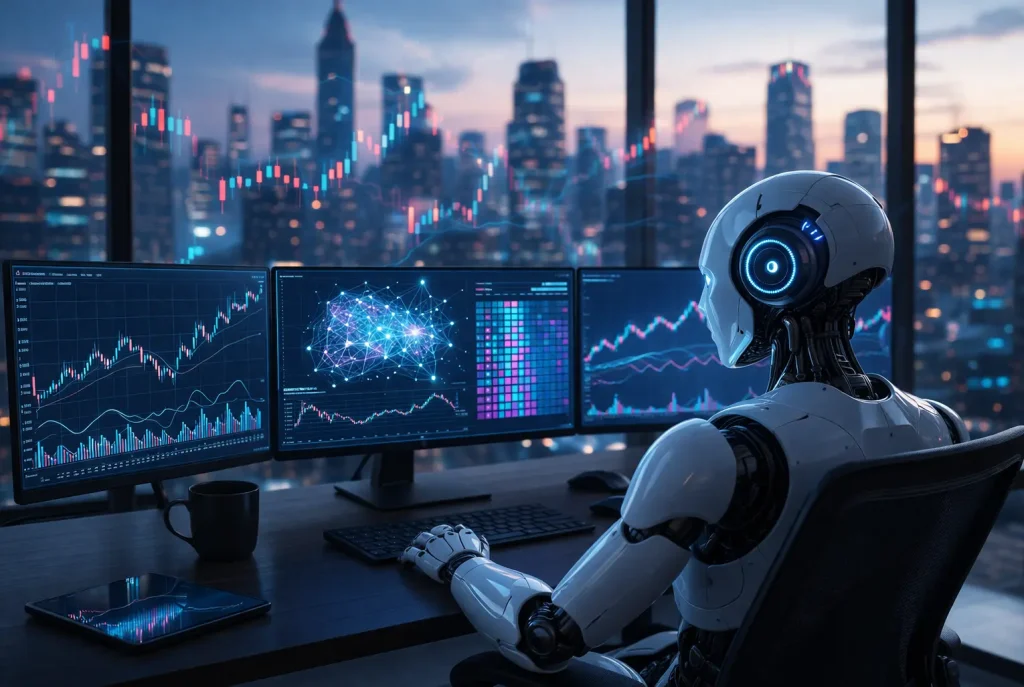
A genuine AI trading platform uses machine learning models to identify patterns in data, natural language processing to extract signals from text-based sources like news and filings, and predictive analytics to generate probability-weighted views on market direction. The better ones also handle execution, placing orders at optimal prices, managing live risk, and adjusting position sizes based on real-time volatility. All of this happens without a human in the decision loop, similar to how structured execution workflows operate within regulated algo trading environments.
That last part is the genuinely new thing. Traditional software is reactive. You look at a chart, you form a perspective, and you make decisions. AI-driven systems are generative. They form perspectives independently, based on processing more data than any analyst could read in a month, and they act on those views in milliseconds.
That gap, between reactive and generative, is where the transformation is happening.
The Mechanics, Briefly
You do not need an engineering degree to trade intelligently with AI. But understanding what is under the hood helps you evaluate what you are actually using.
Machine learning is the engine. These models train on years of historical price data, volume, open interest, sector correlations, earnings cycles, and macro indicators. They find patterns. Not patterns that a human explicitly codes in, like “if RSI crosses 30, flag as oversold.” Patterns the model discovers on its own. Some of those patterns are intuitive. Many are not. The model does not care about intuition. It cares about predictive accuracy across the training set, which is also central to how modern algorithmic trading systems are designed..
Natural language processing is what lets the platform read. SEBI circulars, RBI policy statements, management commentary from earnings calls, financial news across three languages, and social media chatter around a stock. NLP extracts sentiment and signals from all of it, in real time. A CEO’s unusually cautious choice of language on an earnings call can register as a negative signal before most investors have finished listening.
Predictive analytics then takes those inputs and generates forward-looking probabilities. Not certainties. But a statement like “given current IV crush and sector rotation patterns, there is a 68% historical probability of this setup resolving upward in the next three sessions” is more useful than guessing.
Algorithmic execution closes the loop. Signals generated, order placed, risk parameters enforced, all within a timeframe that human reflexes cannot compete with, particularly when integrated with derivatives-enabled execution through a futures trading platform
Why It Matters More in India Than You Might Think
For most of India’s equity market history, this kind of infrastructure belonged exclusively to the big players. FIIs running quantitative desks. Domestic institutions with proprietary data subscriptions and teams of quants. The retail investor, the individual sitting in Nagpur or Surat watching Sensex commentary on their phone, was playing a fundamentally different game. Same market. Radically different toolkit.
That asymmetry is narrowing now, and the numbers back it up. India’s AI trading platform market is projected to grow at a CAGR of around 25% through 2030, reaching approximately USD 2.3 billion. A significant portion of that growth is retail-driven. Not institutional. Increasing access to automation-enabled execution through mobile-first platforms, such as a modern stock trading app, is one of the factors accelerating this shift.
And SEBI’s 2024 proposal to allow retail participation in exchange-vetted algorithmic trading via broker APIs is not incidental to that growth. It is an official acknowledgement that the regulator sees this as the direction the market is heading.
What Good AI Looks Like in Practice
Concepts are fine. But what does this actually look like on a daily basis?
Say the RBI announces a surprise rate decision mid-session. A retail trader monitoring things manually sees the headline, tries to recall which sectors typically benefit or suffer from rate changes, checks a few tickers, and maybe acts on one of them. The whole process takes ten to twenty minutes, and by then, the first wave of the move has already been priced in.
An AI trading platform processes that same headline in milliseconds. It cross-references the rate decision against historical precedents from similar macro contexts, identifies which sectors and individual names have the strongest directional response patterns, generates ranked signals, and can place orders before most human traders have finished reading the notification on their phone. In practice, these workflows typically operate alongside broker-integrated execution layers connected through a trading account.
That speed differential is enormous. It is not about replacing judgment. It is about compressing the time between information and action so that judgment can be applied while the trade is still available.
For options traders specifically, the complexity layer goes even deeper. Managing delta, gamma exposure, volatility skew, and event risk around quarterly results, all of it manually, is genuinely difficult. AI-driven tools analyse live option chains, assess where implied volatility sits relative to historical norms, and suggest spread structures that match both the market environment and the trader’s directional view, which is closely related to how structured derivatives trading strategies are evaluated in practice.
Again, this does not make decisions for you. It makes better-informed decisions possible.
The Limitations
Let us be honest about what AI cannot do, because the hype cycle around this technology makes that conversation necessary.
Machine learning models are pattern-recognition systems. They learn from the past. That is the source of their strength, and it is also the hard boundary of their competence. When something happens in markets that has no real historical analogue, the model has no reliable frame of reference. COVID in February 2020. The GameStop squeeze in January 2021. A sudden, coordinated geopolitical shock. In these moments, AI systems trained on ordinary market conditions can produce outputs that are confidently wrong. Confidence is the problem. The model does not know what it does not know.
Overfitting is a related and persistent issue. A model trained too tightly on historical data learns the noise along with the signal. It looks brilliant in backtests. It falls apart in live conditions because the specific noise patterns it memorised do not repeat in exactly the same way. Good platform design includes validation processes to mitigate this. But it cannot eliminate the problem entirely.
And this one is important: no AI trading platform compensates for not understanding the market you are trading. Tools are not a substitute for knowledge. They are a multiplier of it.
The Broader Shift Underneath All of This
Zoom out far enough, and a larger story comes into focus. The democratisation of sophisticated market infrastructure is genuinely unprecedented. Ten years ago, the kind of multi-factor real-time analysis that AI platforms now offer retail users existed only inside the technology stacks of the biggest trading firms. You could not buy it. It was not for sale at any price if you were an individual.
Now it largely is. Imperfection, in varying degrees of sophistication, with varying levels of regulatory maturity across brokers. But the trajectory is clear, and it is not reversing.
Roughly 60% of new retail investors in India currently use fintech apps that incorporate some form of AI, whether for stock screeners, personalised portfolio advice, or automated rebalancing. As SEBI’s regulatory framework matures around retail algo access, that percentage will go up