India’s economic relationship with the Gulf region has expanded steadily over the past decade. Energy cooperation, growing business partnerships, and the presence of a large Indian workforce have strengthened connections between India and Gulf economies.
Because of these deep linkages, developments in the Middle East are closely watched by policymakers, businesses, and investors in India. Periodic geopolitical tensions in the region can influence global oil markets, shipping routes, and financial sentiment. Understanding how these factors interact is important for evaluating their potential impact on India’s broader economic landscape.
Table of Contents
The Gulf Region’s Strategic Importance for India
The Gulf region plays a crucial role in India’s economic ecosystem. Several Gulf countries are among India’s largest suppliers of crude oil and natural gas, making the region essential for India’s energy requirements.
Beyond energy, the region also hosts a large Indian diaspora that contributes significantly to remittance inflows. These remittances support household consumption and financial stability in many parts of India.
Economic cooperation between India and Gulf nations has also strengthened through bilateral agreements, infrastructure partnerships, and collaboration in sectors such as logistics, renewable energy, and technology.
Energy Markets and Oil Price Volatility
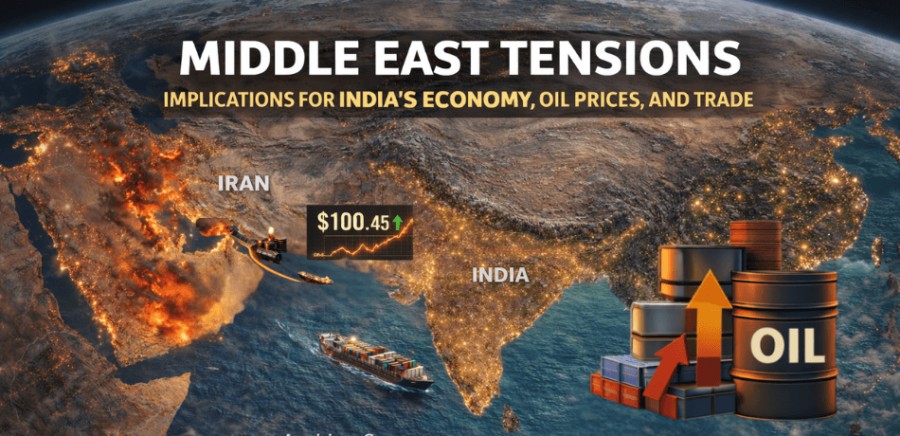
One of the most immediate economic effects of geopolitical tensions in the Middle East is volatility in global energy prices.
The region accounts for a substantial share of global oil production and exports. Any disruption in production facilities or transportation routes can lead to fluctuations in international crude oil prices.
For India, which imports a large portion of its energy needs, rising oil prices can increase import costs and put pressure on inflation. Higher energy prices can also influence transportation costs, manufacturing expenses, and overall economic activity.
Global Shipping Routes and Supply Chain Risks
The Middle East is home to some of the world’s most important maritime trade routes. These shipping corridors play a vital role in transporting oil and other commodities to global markets.
If geopolitical tensions escalate, shipping routes may face higher security risks. This can lead to increased insurance costs for cargo vessels and potential delays in supply chains.
For an economy like India that depends heavily on international trade for energy and industrial inputs, disruptions in these routes can affect logistics costs and supply chain efficiency.
Financial Markets and Investor Sentiment
Periods of geopolitical uncertainty often lead to cautious behaviour in global financial markets.
Investors may temporarily shift toward safer assets when geopolitical risks increase. This can sometimes lead to short-term volatility in equity markets, currency movements, or commodity prices.
While these fluctuations are usually temporary, they can influence short-term capital flows and business sentiment in emerging markets, including India.
The Role of the Indian Diaspora
Another important economic link between India and the Gulf region is the large Indian diaspora living and working in Gulf countries.
Millions of Indian professionals and workers contribute to various sectors across the region, including construction, healthcare, finance, and technology. Their remittances form a significant component of India’s foreign exchange inflows.
Stable economic conditions in Gulf economies help sustain employment opportunities and remittance flows for Indian workers.
Long-Term Economic Resilience
Despite occasional geopolitical tensions, economic engagement between India and Gulf countries has continued to strengthen over time.
India has been working to diversify its energy sources, expand renewable energy capacity, and build strategic petroleum reserves. These measures help reduce vulnerability to short-term disruptions in global energy markets.
At the same time, ongoing economic cooperation with Gulf economies continues to create opportunities for infrastructure development, technology partnerships, and long-term growth.
Conclusion
The Middle East remains an important region for India’s energy security, economic stability, and global connectivity. Developments in the region can influence oil prices, shipping routes, and financial markets, all of which have implications for India’s economy.
Rising geopolitical tensions in the region could therefore have broader economic effects for India, particularly through higher energy import costs, increased logistics expenses, and fluctuations in financial markets. These factors may influence inflation, trade balances, and business sentiment, making global developments in the Middle East an important consideration for policymakers and businesses in India.
While geopolitical tensions may create temporary uncertainty, India’s long-standing engagement with Gulf economies and its efforts toward economic diversification help strengthen resilience in an interconnected global environment.
Disclaimer: The information provided in this article is for general informational purposes only and should not be considered financial or investment advice. Readers are advised to consult qualified professionals before making any investment decisions.