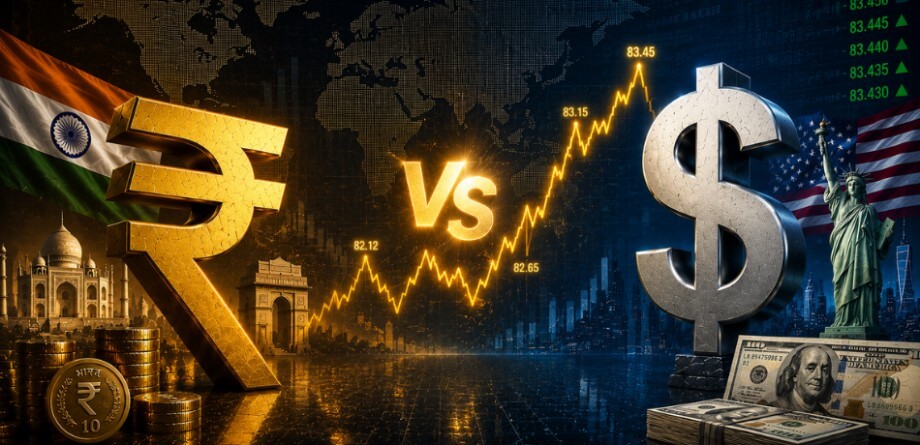
The movement of the rupee against the US dollar is one of the most-watched indicators in the financial markets. Whether it is the dollar rate today or the long-term trend in the USD-to-INR exchange rate, currency fluctuations directly influence inflation, trade, foreign investment and overall economic stability.
The recent global uncertainty, rising interest rates, crude oil volatility and geopolitical tensions have made the Rupee vs Dollar exchange rate more important than ever for understanding India’s economic direction.
Table of Contents
Understanding the relationship between USD-INR and Currency Movement
The USD-to-INRconversion rate shows how many rupees are required to buy one US dollar.
For Example, at present, we can buy one USD for ₹95.12; if it becomes ₹96 tomorrow, it means the rupee has weakened or depreciated.
* If it becomes ₹94.12 tomorrow, it means the rupee strengthens or appreciates.
A weaker Indian Rupee raises import costs, whereas a stronger rupee lowers them. As India relies heavily on imports such as crude oil, electronic goods, and machinery, even minor currency fluctuations can significantly affect the economy.
The value of the rupee in relation to USD is therefore critical for controlling inflation, the trade balance, and investment flows.
Key Reasons: Why the Indian rupee is falling:
There are various structural and global factors behind Indian rupee depreciation:
1. Crude Oil Dependence
India imports most of its crude oil and pays in dollars, the universal currency. As a result, demand for dollars increases, weakening the rupee.
2. Interest Rate Differentials
Higher US interest rates attract capital towards the dollar, reducing capital flows into emerging markets like India.
3. Trade Deficit
Whenever Indian imports exceed exports, India needs dollars for payments, which pressures the rupee.
4. Foreign Portfolio Investor (FPI) Flows
The dollar is a robust, globally accepted currency with high interest rates, which fosters a favourable environment for Foreign Portfolio Investors. This situation leads to capital outflows from India, putting downward pressure on equity markets and currency sentiment.
5. Global Uncertainty
Global tensions, war, and slowdowns in economies increase demand for safe-haven currencies like the US Dollar
The above factors explain why the Indian rupee is falling during periods of stress.
Impact of Global Wars and Geopolitical Tensions
Global conflicts directly affect the currency markets.
During times of war or geopolitical tensions,
- Investors look to shift to safe-haven assets like the USD.
- Sharp rise in crude oil prices.
- Supply chains get disrupted.
- Inflationary pressures are increasing globally.
As India imports most of its oil, any impact on oil prices increases import bills, widens the trade deficit, and pressures the rupee.
Such conditions often lead to increased volatility in the USD-to-INR exchange rate.
Impact on the Economy:
1. Imports Increase in Cost
A weaker rupee increases the cost of oil, electronic items, gold, and machinery, leading to higher production and transportation costs in dependent industries.
2. Inflation Pressure
Higher costs of goods import impact prices in the economy, leading to higher prices for goods imports and relevant domestic production. This impacts the supply chain and the prices of everyday essential and edible items. Inflation diminishes the buying power of consumers and slows down the economy
3. Export Competitiveness
A weaker rupee benefits exporters by reducing the cost of Indian goods for overseas markets.
The key sectors include IT services, pharmaceuticals, textiles, and chemicals. Export-oriented units often report higher revenues when the dollar strengthens.
4. Impact on Stock Market:
Movement in currency, whether it’s dollars or rupees, affects equity markets.
It is of utmost importance to understand how currency depreciation impacts stock prices.
- Exporters benefit from dollar revenue; however, when the dollar appreciates or strengthens, import-heavy companies face margin pressure.
- Whenever the USD moves, it increases volatility in the market.
A strong dollar environment frequently exerts short-term pressure on equities.
5. Foreign Investment Flows:
Investment by global investors (FPI’s) based on the strength or risk sentiment of the currency.
Strengthening of the dollar can lead to:
- Outflow of Foreign Portfolio Investments from India.
- High market volatility.
- Decreases liquidity in equities.
The actions of foreign investors directly affect market stability and valuation trends.
Best Sectors to Invest When Rupee Falls
During periods of rupee weakness or depreciation, investors often look for the best sectors to invest in.
Sectors where an investor can invest:
- Information Technology (high USD revenue exposure)
- Pharmaceuticals
- Textiles
- Speciality chemicals
Sectors under pressure:
- Aviation (fuel imports)
- Oil Companies
- Import-dependent industries and manufacturing units.
- FMCG (raw material cost pressure)
Export-driven businesses generally perform best during sustained rupee depreciation cycles.
Impact on Common Citizens: Currency fluctuations affect individuals’ lives in various ways. Whenever the rupee weakens, it directly impacts inflation, i.e., overseas education, foreign travel, and imported goods like gadgets become more expensive. It also increases the price of gold, which India imports and that Indians have used as a safe-haven asset.
However, if an Indian receives foreign remittances, the remittances become more valuable, benefiting the households that receive them.
Role of RBI in Managing USD-INR Volatility
The Reserve Bank of India plays a vital role in stabilizing currency fluctuations.
Its tools include:
- Forex reserve intervention
- Dollar buying/selling
- Liquidity management
- Interest rate adjustments
India’s strong forex reserves help reduce volatility in the USD-to-INR market, even during global shocks.
Is a depreciation of the rupee always bad?
It is not necessary that when the rupee weakens, it is always bad for the economy.
Negative impacts:
- High Import cost
- Increase in prices (inflation)
- Burden on consumers
Positive impacts:
- Supporting the export sector by better earnings
- High value of dollar exchange/remittance value
- Competitiveness for Export units.
- Beneftiing the industrial unit based on export.
The overall impact depends on the balance between exports, imports, inflation and capital flows.
Conclusion
The Rupee vs Dollar movement reflects a combination of economic fundamentals and global financial conditions.
Whether tracking the USD-to-INR rate or observing the USD rate today, currency movements offer insight into India’s economic health.
From inflation and the trade balance to stock markets and foreign investment, the reasons for the Indian rupee’s depreciation are closely linked to oil prices, interest rates, and geopolitical developments.
Understanding the value of the rupee in the economy helps investors, businesses and individuals interpret financial trends more effectively and make informed decisions in an increasingly interconnected global economy.
Disclaimer: The article above is just for educational purposes; Share India do not recommend to invest / trade in any currency. Investor are advised to consult their financial advisor before any investment.