Many traders face the same issue:
You can know exactly what the right decision is and still not make it. You can have a clear plan, a defined stop-loss, an entry rationale you wrote down the night before, and still, in the moment, do the opposite. Not because you forgot the plan. Because something else took over.
That something is emotion. And in trading, it is not a peripheral concern or a soft skill to develop someday. It is the central variable. The one that determines whether all the technical knowledge you have accumulated ever translates into actual results.
Research puts a number on it: roughly 85% of long-term trading performance is attributable to psychological factors rather than strategy quality. Think about the implications of that for a moment. It means two traders running the same strategy, same stocks, same market conditions, can produce vastly different outcomes purely based on how they manage what happens inside their heads. The strategy is almost incidental.
Most traders spend maybe 5% of their development time on psychology. The other 95% goes to charts, indicators, screeners, and setups. That allocation is backwards, and the market collects payment for it regularly.
Table of Contents
The Architecture of the Problem
Before getting into specific emotions and how they distort decisions, it helps to understand why this happens at all.
The human brain did not evolve for trading. It evolved for survival in environments where threats were immediate, physical, and required fast, binary responses. A loud noise in the forest: freeze or run. Food in sight: eat now, storage is unreliable. These instincts served our ancestors extraordinarily well. They serve traders extraordinarily badly.
Markets require the opposite of survival-brain thinking. Sitting with uncertainty rather than resolving it urgently. Letting a loss continue, temporarily, because the strategy says it should. Not acting when everything in your body is screaming to do something. The part of your brain that processes financial loss activates the same neural pathways as physical pain. That is not a metaphor. It is neuroscience. The sensation of losing money is, at the biological level, painful. Your brain wants the pain to stop. Cutting the losing trade stops it. So you cut it, long before the strategy said to, because the pain of waiting was unbearable.
Understanding that this is happening, that the urge to exit a trade early or chase a missed move is coming from survival circuitry rather than rational analysis, is the beginning of managing it.
Fear: The One That Shows Up First
Fear dominates trading psychology. Not greed. Fear.
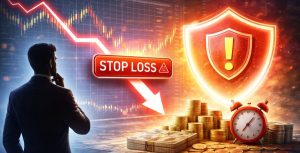
It wears several faces, and not all of them are obvious. The most visible is panic. The position moves against you. The loss builds. Your stop-loss level, which felt entirely sensible two days ago when the trade was a hypothesis, now feels arbitrary and cruel. So you adjust it. Move it down. Or you freeze entirely and watch the loss deepen, telling yourself it will recover, waiting for a reversal that may never arrive.
This is fear of realising a loss. It is among the most reliably destructive impulses in all of trading. The loss is real whether or not you close the trade. Moving the stop-loss does not reduce the loss. It defers the pain and, almost always, increases it.
Then there is FOMO. Fear of missing out sounds like enthusiasm, but it is fear with an aggressive mask on. You watch a stock run 6% in a session you were not positioned for. Others made money. The anxiety of being left behind overrides any rational assessment of whether buying at this point, after the move has already happened, makes any sense. You chase. The stock reverses. The trade that felt urgent an hour ago now looks obviously wrong in hindsight. It was obvious then, too. Fear just made it invisible.
Physiological research on trading psychology adds a specific and useful finding here. Traders who experience emotional responses in anticipation of decisions, rather than purely in reaction to outcomes, tend to perform better. Awareness of how you are likely to feel before a situation develops gives you a window to respond intentionally rather than react instinctively. That window is small. But it is there.
Greed: Quieter and Equally Destructive
Greed does not arrive dramatically. That is what makes it hard to catch.
It shows up as confidence. The trade is working. The target has been hit. But the momentum still looks strong, and exiting feels premature, like getting off a moving train one stop early. So you hold. The position gives back a third of the gain. Then half. Then, still holding, nearly all of it. Eventually, you exit below where the strategy told you to and call it bad luck.
It was not bad luck. It was greed dressed as conviction.
The neurochemistry underneath this is worth knowing. Profitable trades release dopamine. The brain registers the winning decision as behaviour worth repeating, including whatever risk-taking happened to work out in that particular instance. A string of wins does not sharpen judgment. It inflates confidence. And in markets, unearned confidence has a way of getting corrected in single, concentrated episodes.
Overconfidence bias is one of the best-documented phenomena in behavioural finance. Multiple studies across emerging markets in 2024 and 2025 confirm what the broader literature established decades ago: overconfident traders increase position sizes, loosen risk parameters, trade more frequently, and underperform more disciplined traders on a risk-adjusted basis. The mechanism is nearly always the same. A sequence of successes. Swelling certainty. One oversized position in adverse conditions. A loss that undoes months of gains.
Loss Aversion: The Bias That Is Older Than Markets
In the 1970s, Daniel Kahneman and Amos Tversky documented something that economic theory of the time could not accommodate. Losses and gains of identical size do not feel identical. The psychological weight of a loss is approximately twice the psychological pleasure of an equivalent gain. They called it loss aversion. It is probably the single most consequential bias for traders.
The trading expression of loss aversion is called the disposition effect. Traders close winning positions prematurely to lock in the gain. They hold losing positions far too long because closing the trade makes the loss irrevocably real. The open position still holds hope. It might recover. The math says cut it. The mind says wait.
This is the exact inversion of what sound risk management demands in leveraged market participations. Every serious trader knows the principle: cut losses short, let winners run. Almost every serious trader has also spent years struggling to actually do this in live markets, because loss aversion is not a logical error. It is a deeply embedded emotional response that operates faster than conscious reasoning.
Research specifically examining NSE and BSE retail investor data confirms that loss aversion and its cousin, herd behaviour, are among the most statistically significant predictors of underperformance in Indian retail trading. This is not abstract theory imported from Western academic literature. It is visible in the live behaviour of Indian retail traders. The bias is universal. The market context is local.
The Herd: Comfort in Numbers, Danger in Practice
Following the crowd is a survival instinct. For most of human history, in most situations, it was adaptive. If everyone around you is running, running is probably the right idea.
Markets punish it.
By the time a trade idea has become consensus, audible in WhatsApp groups and financial media, the people who positioned early have already made most of the money. The traders arriving at that point are frequently buying near the peak of a move that is running on social momentum rather than fundamental change. The same crowd that drove the price up will eventually drive it back down, panic-selling for the same reasons they panic-bought: because everyone else is doing it.
This is how bubbles work at the macro level. It is also how individual traders lose money at the micro level every single week. A tip from a colleague. The stock dominating Telegram chatter. The sector everyone on Twitter is suddenly excited about. These are social signals. And acting on them without independent research is not trading. It is a delegation without accountability.
Herd psychology also operates defensively. The reluctance to take a contrarian position, even when your own analysis supports it, because being wrong in a crowd feels better than being wrong alone. The market does not grade on a curve. It does not care whether you had company in your mistake.
Confirmation Bias: The Evidence You Choose Not to See
You form a view. Now the filter goes up.
Information that supports your thesis feels credible and significant. Information that contradicts it feels noisy, overblown, and probably wrong. The analyst who agrees with you seems perceptive. The one who disagrees seems to be missing something. Your conviction increases steadily, not because the quality of evidence improved, but because you stopped processing the part of it that challenged you.
Confirmation bias is present in essentially every human being who has ever held an opinion about anything. In trading, it shows up as positions held well past the point where the original thesis stopped being valid. The trader who bought a stock for a specific catalyst, and then holds it through deteriorating fundamentals because they are still hoping the original catalyst plays out, is running on confirmation bias.
The corrective requires deliberate structure. Write the thesis down before entering the trade. Specifically include: what would tell me this thesis is wrong? When that evidence arrives, treat it as information rather than noise. This sounds straightforward. It is not, because every rationalisation feels entirely reasonable from the inside. The journal you keep will, over time, show you the pattern. You will see the trades where you held despite clear contrary evidence, again and again, until the loss eventually became impossible to ignore.
What Actually Helps: Practical Tools, Not Platitudes
The problem with most trading psychology advice is that it stops at diagnosis. Here is what actually creates change.
A written trading plan is the foundation. Not a mental framework. A physical document with specific, non-negotiable rules: entry criteria, exit criteria, maximum position size as a percentage of account capital, and maximum daily drawdown limit before stopping for the day. The plan does not prevent emotional responses. It gives you something concrete to return to when emotional responses are actively trying to override your judgment. In a live trade, the plan is the anchor.
A trade journal is the most underused performance tool in retail trading for individual market participants. Log every trade: the setup, the rationale, the entry, the management decisions during the trade, the exit, and specifically how you felt at each stage. Over weeks and months, patterns become unmistakable. You exit too early on high-volatility days. You hold losing stocks longer when position sizes are above your normal range. You overtrade in the session after a significant loss, trying to recover quickly. None of these patterns is visible from memory alone. All of them are clearly visible in a journal.
Predefined risk limits remove the most dangerous decisions from the emotional arena entirely. If the rule is never to risk more than 1.5% of account capital on a single trade, the stop-loss placement is not something you renegotiate mid-trade. The decision was made when a stock was stable and the thinking behind it was clear. Changing it under live market pressure is the emotional brain overriding the rational one. Do not give it the opportunity.
Breaks are a legitimate trading tool. Not a concession to weakness. Continuing to trade through exhaustion, frustration, or a bad streak compounds errors in a highly specific way: it combines deteriorating judgment with larger emotional reactions to outcomes, because losses hurt more when you are already stressed. Walking away mid-session when the day is going badly preserves capital in a real and measurable way.
And finally, there is the cognitive reframe that separates traders who last from traders who do not: accepting that individual trade outcomes are not verdicts on judgment. Even a well-constructed strategy with strong historical performance produces losing trades. A single loss is one data point in a distribution. Evaluating performance across a series of trades rather than agonising over each individual outcome changes the relationship with loss fundamentally. The trade that did not work is not a referendum on your ability. It is a sample. Act accordingly.
The Edge Nobody Talks About Enough
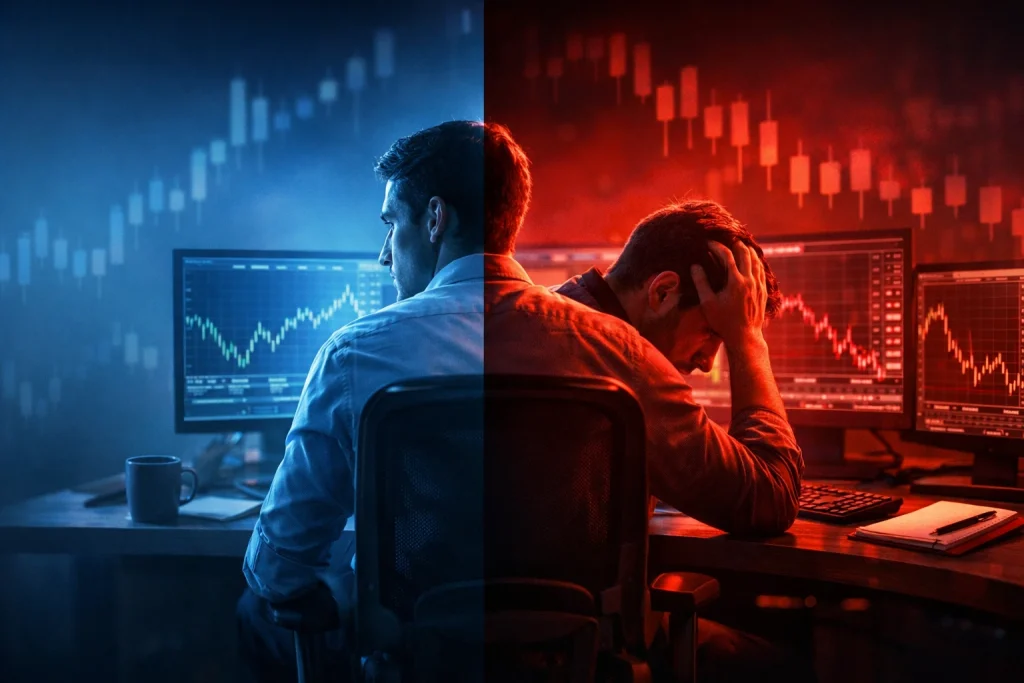
Two traders. Identical strategies. Identical markets. Identical tools.
One manages the psychological dimensions of their trading actively. The other does not. Over time, over hundreds of trades, the performance gap between them will dwarf any edge their technical approach could have provided.
This is the real lesson of trading psychology. Not that you should feel better about losing trades. Not that meditation will make you profitable. But that your strategy has a maximum possible performance, and how close you actually get to that maximum is determined, overwhelmingly, by what happens in your head between the signal and the order.