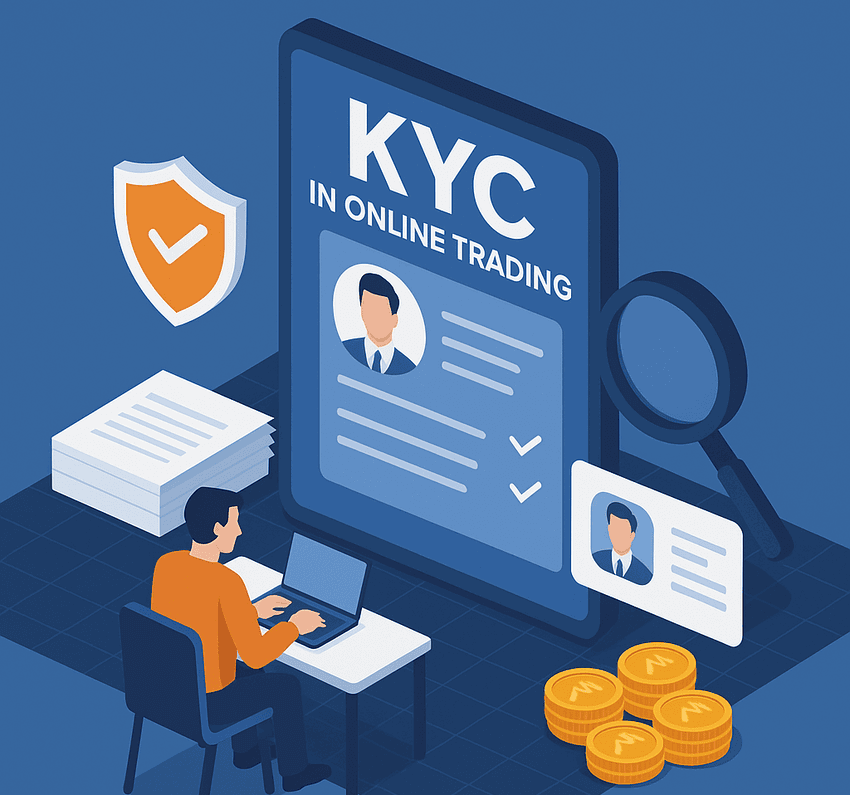
When you open an account with any online trading platform, including Share India, one of the very first steps you complete is the KYC process—short for Know Your Customer. While it may appear to be a routine onboarding requirement, KYC is in fact a critical pillar of safe, transparent, and compliant online trading.
In today’s digital-first markets, where trades are executed in seconds and funds move electronically, KYC plays a vital role in verifying investor identities, assessing risk, preventing misuse, and ensuring adherence to regulatory standards. A robust KYC framework not only protects trading platforms but also safeguards investors and strengthens trust across the financial ecosystem.
This blog explains what KYC in online trading means, why it is essential, and how platforms such as Share India implement KYC to offer a secure, compliant, and seamless trading experience.
Table of Contents
What Is KYC in Online Trading?
KYC (Know Your Customer) is a regulatory process used by financial institutions and market intermediaries to verify the identity of their clients and understand their financial profile before granting access to trading services. In the context of online trading, KYC ensures that every trading and Demat account is linked to a genuine, identifiable individual or entity.
The KYC framework follows a risk-based approach and generally consists of three key components:
1. Customer Identification Program (CIP)
This step focuses on collecting core personal details required to establish the investor’s identity, including:
- Full name
- Date of birth
- Residential address
- Permanent Account Number (PAN) (mandatory)
- Aadhaar number or other officially valid documents, where Aadhaar is voluntarily used to enable faster digital e-KYC
2. Customer Due Diligence (CDD)
CDD involves verifying the submitted information and evaluating the client’s risk profile. Factors such as occupation, income range, trading experience, and intended market participation are assessed to determine suitability and risk exposure.
3. Enhanced Due Diligence (EDD)
For higher-risk clients—such as politically exposed persons or entities with complex ownership structures—additional documentation and enhanced monitoring may be required.
Together, these measures help online trading platforms identify investors accurately, manage risk effectively, and offer services responsibly.
Why KYC Matters for Online Trading
1. Preventing Fraud and Financial Misuse
KYC is a cornerstone of anti-money laundering and fraud-prevention frameworks. By verifying identities and monitoring transaction behaviour, trading platforms can identify suspicious patterns such as unusual trading volumes, repeated small-value transactions, or unauthorised account activity.
2. Strengthening Platform and Account Security
A strong KYC process significantly reduces the risk of account impersonation, identity theft, and unauthorised access. As digital fraud techniques become increasingly sophisticated, effective identity verification acts as the first line of defence for both investors and platforms.
3. Ensuring Regulatory Compliance
In India, KYC requirements for online trading are governed by the Securities and Exchange Board of India (SEBI) and implemented through stock exchanges and authorised intermediaries. While KYC norms were initially introduced in the banking system by the RBI, SEBI enforces these standards for capital market participants. Compliance with KYC norms is mandatory for lawful participation in securities markets.
4. Building Investor Trust and Market Integrity
Effective KYC practices signal transparency, accountability, and commitment to investor protection. Traders are more confident engaging with platforms that prioritise identity verification and data integrity, leading to a more stable and trustworthy trading environment.
CKYC and the One-Time KYC Framework
A significant advancement in India’s KYC ecosystem is the introduction of the Central Know Your Customer (CKYC) Registry, which enables a one-time KYC process for investors.
Once an investor completes KYC, their verified details are uploaded to the CKYC Registry through SEBI-registered KYC Registration Agencies (KRAs). A unique CKYC number is generated, which can be used across multiple financial institutions, eliminating the need to repeat KYC procedures.
For traders, CKYC offers:
- Faster account opening across platforms
- Reduced paperwork and duplication
- Consistent and secure handling of personal data
How the KYC Process Works on Share India
Opening a trading or Demat account with Share India involves a streamlined, digital-first KYC process designed to meet regulatory requirements while ensuring investor convenience.
Step 1: Submission of Basic Details
Applicants begin by providing essential information such as name, mobile number, email address, and PAN. These details initiate identity validation.
Step 2: PAN and Aadhaar-Based Verification
PAN details are validated against official records, while Aadhaar-based eKYC, where opted for by the investor, is completed through permitted digital authentication methods, enabling quick, secure, and paperless verification without mandating any specific mode of contact linkage.
Step 3: Document Upload
Investors are required to upload:
- A recent photograph
- Signature (digital or scanned)
- Bank proof, such as a cancelled cheque or bank statement
- Income proof (mandatory for derivatives trading)
Step 4: In-Person Verification (IPV)
As mandated by SEBI, In-Person Verification is a compulsory component of the KYC process. For most individual investors, IPV is completed digitally through video verification, where identity and documents are confirmed in real time. For non-individual clients, IPV may be conducted offline as per regulatory norms.
Step 5: KRA Validation and CKYC Upload
Verified KYC records are validated through SEBI-registered KRAs and uploaded to the CKYC Registry, ensuring regulatory oversight and standardisation.
Step 6: E-Signature and Final Consent
Applicants provide final consent through Aadhaar-based e-signature, formally completing the KYC process.
Step 7: Account Activation and Ongoing KYC Monitoring
Once verification is complete, trading and Demat accounts are activated. KYC is an ongoing obligation—details may be periodically reviewed or updated based on risk categorisation or regulatory requirements.
Benefits of KYC for Share India Users
| Benefit | What It Means for You |
| Secure trading environment | Verified identities help minimise fraud and misuse |
| Regulatory protection | Compliance with SEBI norms safeguards investor interests |
| Fair market access | Uniform verification creates a level playing field |
| Improved service experience | Risk profiling supports better customer assistance |
KYC is not merely a compliance requirement—it reflects a commitment to secure, transparent, and responsible trading.
Why Every Trader Should Care About KYC
- Personal Protection: Robust KYC safeguards trading accounts from unauthorised access and identity misuse.
- Market Integrity: Verified participants contribute to orderly, transparent, and compliant markets.
- Operational Ease: Fully verified accounts face fewer disruptions in fund transfers and withdrawals.
- Future Readiness: A complete KYC profile enables seamless access to additional products such as derivatives, mutual funds, and other investment options.
The Bottom Line
KYC is a fundamental pillar of safe and responsible online trading. Platforms like Share India implement KYC not merely to meet regulatory requirements, but to protect investors, secure transactions, and uphold market integrity.
For traders, KYC ensures smoother onboarding, enhanced protection, and reliable access to a wide range of financial instruments. In an era of rapid digitalisation and evolving financial risks, strong KYC practices are essential to building a secure and trustworthy trading environment.
At Share India, the KYC process is designed to be efficient, compliant, and investor-centric—enabling traders to participate in the markets with confidence.