 Overview
 Leadership
 CSR
CSR Equal Steps
 ESG
ESG News Room
 Investor Relations
 ISO Certification
 Broking Services
 Depository Services
 Mutual Fund
 Research Analysis
 Margin Trading Facility
 Portfolio Management Services
 IPO
IPO Fixed-Income & Structured Instruments
 VWAP
VWAP FII & DII Indicator
 Calculators
 Margin Calculator
 Dividend Yield Calculator
 Options Calculator
 CAGR Calculator
 Trade Cost Calculator
 PMS Calculator
 Trading Platform
 Trading Brokerage
 Demat Account Charges
 Other Trading Charges
 Authorised Person
 Business Partner
 Independent Financial Distributor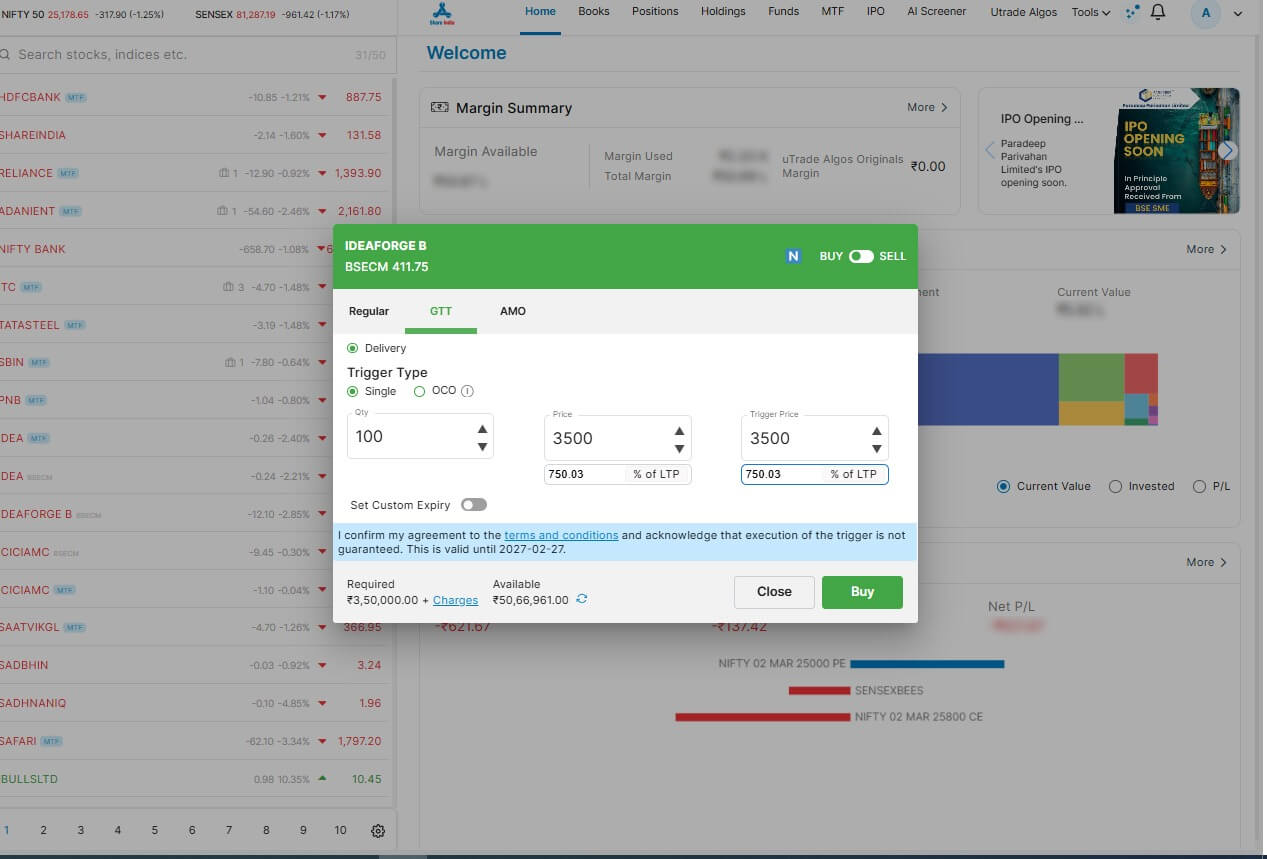
Financial markets offer opportunities every day — but tracking price movements throughout the trading session is not always feasible for every investor. Many market participants identify ideal price levels to enter or exit a stock but may miss execution due to time constraints, professional commitments, or sudden market volatility.
This is where a GTT (Good Till Triggered) order provides a practical solution. A GTT order enables investors to set a predefined trigger price for buying or selling a security. Once the market reaches this level, the system automatically places the order on the exchange, helping investors translate planned strategies into potential execution without continuous monitoring.
For beginners, it simplifies disciplined investing by converting intent into actionable orders. For experienced participants, it supports structured entry, exit, accumulation, and risk-management strategies. By combining automation with investor intent, GTT orders serve as an effective tool for planning trades in advance — allowing market participation with greater convenience and strategic clarity.
Table of Contents
What is a GTT Order?
A Good Till Triggered (GTT) order is a pending instruction that remains active until one of the following events occurs:
- The specified trigger price is reached
- The order is successfully executed after trigger activation
- The order is cancelled by the client
- The validity period expires
In essence, a GTT order allows investors to pre-define entry or exit levels so that trading decisions can be executed even when they are not actively tracking the market.
How GTT Orders Work
The GTT mechanism typically operates in two stages:
1. Order creation
The investor specifies key parameters such as quantity, trigger price, and limit price. This instruction is stored within the broker’s system.
2. Trigger activation
When the market price satisfies the trigger condition, the system automatically converts the instruction into a regular exchange order for potential execution.
The broker’s role is largely technological — monitoring price conditions, storing instructions, and transmitting the order to the exchange when the trigger criteria are met.
How to Place a GTT Order through Share India
Through the Share India Mobile App
Step 1: Log in
Open the Share India Mobile App and sign in using your registered credentials.
Step 2: Navigate to the Home Screen
After login, you will land on the Home Screen of the application.
Step 3: Access the GTT Section
- Go to Products & Tools and select GTT Book.
- Click Create GTT and search for the scrip on which you wish to create the order.
- Alternatively, select a scrip directly from your Watchlist to initiate GTT creation.
Step 4: Enter Order Details
- Choose Buy or Sell.
- Enter Quantity, Limit Price, and Trigger Price.
Step 5: Confirm Order
Click Buy/Sell to confirm and place the GTT order.
All active GTT orders can be viewed under the Order section, where you may also create additional instructions.
Through the Share India Web Trading Platform
Step 1: Log in
Visit the Share India Web Trading Platform and log in using your credentials.
Step 2: Open the Book Menu
From the dashboard, navigate to the Book Menu. You may also use your Watchlist to initiate GTT creation.
Step 3: Create GTT
- Under the Book Menu or Watchlist, click Create GTT.
- Select the desired scrip.
Step 4: Enter Order Details
- Select Buy or Sell.
- Enter Quantity, Limit Price, and Trigger Price.
Step 5: Confirm Order
Click Buy/Sell to confirm and place the order.
Validity of GTT Orders
GTT orders generally remain valid for up to 364 days or until derivative contract expiry, depending on segment applicability. This extended validity eliminates the need to repeatedly place orders for positional strategies, accumulation plans, or predefined exit levels.
Placing, Modifying, and Cancelling GTT Orders
Clients can place, modify, or cancel GTT orders only through the broker’s mobile application or web trading platform. Operational requests via offline channels such as phone calls, SMS, or email are typically not accepted for order modifications or cancellations.
In addition to order management functionality, certain operational requirements apply specifically to sell-side GTT instructions.
Sell GTT Orders and Authorization Requirements
For delivery-based sell GTT orders, investors should ensure:
- Shares are available in the Demat account on trigger day
- TPIN & EDIS authorization is completed (where applicable) after trigger
- Required broker authorizations such as DDPI are active
Failure to meet these requirements may result in rejection of the order even after trigger activation.
Benefits of Using GTT Orders
1. Convenience: Investors can define target or stop-loss levels without continuously monitoring market movements.
2. Discipline: Pre-defined execution levels help minimize emotional trading decisions and impulsive actions.
3. Long-term planning: Extended validity supports positional strategies, staggered accumulation, and structured exits.
4. Automation: System-driven monitoring enhances execution readiness and strategic alignment.
Important Risks and Considerations
Despite these advantages, investors should remain aware of certain operational and market-linked limitations. Execution of GTT orders is not guaranteed and may be affected by:
- Market liquidity constraints
- Circuit filters or trading halts
- Price gaps between trigger and execution
- Counterparty availability
- Exchange or technical disruptions
Investors are therefore encouraged to periodically review active GTT orders to ensure they remain aligned with prevailing market conditions and portfolio objectives.
Conclusion
GTT orders represent a strategic trading utility that bridges automation with investor intent. By enabling advance price-based order placement with extended validity, they support disciplined investing, operational convenience, and structured portfolio management.
However, investors should understand that GTT orders function as trigger-based instructions rather than assured executions. Periodic monitoring, awareness of market conditions, and proper authorization readiness remain essential for effective utilization. When used thoughtfully, GTT orders can become a valuable component of a modern investor’s trading toolkit.
Disclaimer: The information provided above is for educational and informational purposes only and does not constitute investment advice, recommendation, or solicitation to buy or sell any securities. GTT (Good Till Triggered) orders are trigger-based instructions and do not guarantee execution. Order execution is subject to market conditions, liquidity availability, exchange regulations, and system performance. Investors are advised to assess their risk profile and consult their financial advisor before making investment decisions.