 Overview
 Leadership
 CSR
CSR Equal Steps
 ESG
ESG News Room
 Investor Relations
 ISO Certification
 Broking Services
 Depository Services
 Mutual Fund
 Research Analysis
 Margin Trading Facility
 Portfolio Management Services
 IPO
IPO Fixed-Income & Structured Instruments
 VWAP
VWAP FII & DII Indicator
 Calculators
 Margin Calculator
 Dividend Yield Calculator
 Options Calculator
 CAGR Calculator
 Trade Cost Calculator
 PMS Calculator
 Trading Platform
 Trading Brokerage
 Demat Account Charges
 Other Trading Charges
 Authorised Person
 Business Partner
 Independent Financial Distributor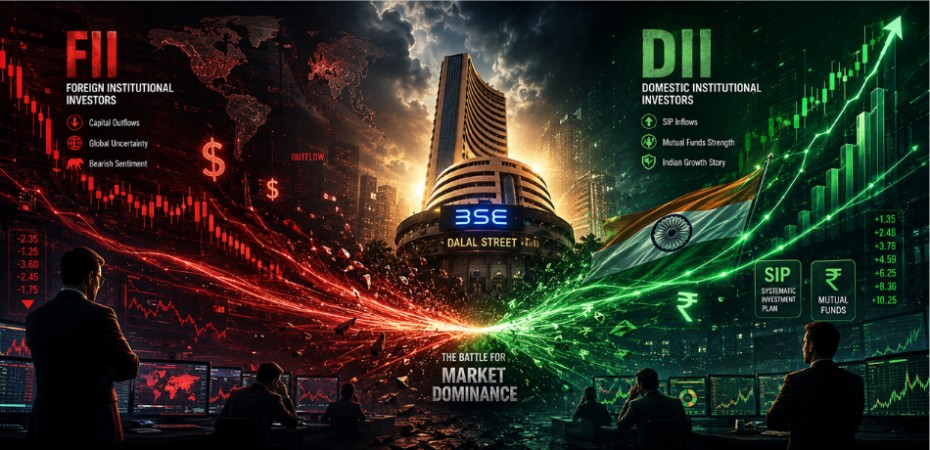
Table of Contents
Introduction: The Silent Power Shift on Dalal Street
Why does the Indian stock market sometimes rise even as foreign investors sell aggressively? And why do markets suddenly rally when global funds turn buyers?
Welcome to the FII vs DII battle — one of the most powerful yet least understood forces driving Dalal Street today.
For decades, the Indian stock market was largely at the mercy of Foreign Institutional Investors (FIIs). A single wave of global selling could trigger sharp corrections, while foreign inflows powered massive bull runs.
But something has changed.
A structural transformation is underway — domestic money is rising, retail participation is expanding, and Domestic Institutional Investors (DIIs) are increasingly challenging foreign dominance. The question investors are asking in 2026 is clear:
Who really controls the Indian stock market now — FIIs or DIIs?
Understanding FIIs and DIIs in the Indian Stock Market
Foreign Institutional Investors (FIIs) are overseas entities such as global mutual funds, hedge funds, sovereign wealth funds, and pension funds investing in Indian equities. Their decisions depend largely on global interest rates, dollar strength, inflation trends, and geopolitical risks.
Domestic Institutional Investors (DIIs) include Indian mutual funds, insurance companies, banks, and pension funds that invest domestic savings into equity markets.
The interaction between FII flows and DII flows has become a key indicator of stock market direction.
When FIIs Ruled Dalal Street
Historically, FIIs were the undisputed drivers of Indian equities.
- Strong FII inflows → Bull market rallies
- Heavy FII selling → Market corrections
Indian markets were deeply linked to global liquidity cycles. Events such as US Federal Reserve rate hikes, global recession fears, or currency volatility often trigger capital outflows, leading to sharp swings in benchmark indices like Nifty 50 and Sensex.
This made Dalal Street highly dependent on foreign capital.
The Rise of DIIs: India’s Structural Market Shift
Over the past few years, India has witnessed a remarkable transformation in market participation.
Key factors driving DII dominance:
- Record monthly SIP inflows
- Rapid growth in retail investor accounts
- Increasing financial literacy
- Shift from physical assets to financial investments
- Expansion of insurance and retirement funds
DIIs now consistently absorb foreign selling pressure. Even during large FII outflows, markets have remained resilient — signalling a structural shift in ownership.
India is transitioning toward a domestically supported equity market.
Who Is Driving Dalal Street Today?
FIIs: Masters of Market Momentum
FIIs still influence:
- Short-term market direction
- Valuation expansion
- Large-cap rallies
- Currency-sensitive sectors like IT and banking
Global liquidity continues to determine risk appetite.
DIIs: The Market Stabilizers
DIIs are increasingly:
- Supporting markets during corrections
- Providing long-term capital stability
- Reducing extreme volatility
Today’s Dalal Street operates as a dual-engine market, powered by both global and domestic liquidity.
Why This FII vs DII Shift Matters for Investors
The evolving ownership pattern reflects deeper economic strength:
- Financialization of Indian household savings
- Reduced dependence on foreign capital
- Improved market maturity
- Stronger long-term investment ecosystem
Corrections may now be less panic-driven compared to earlier cycles, though global cues remain influential.
Key Indicators Investors Should Track
To understand who is driving markets, monitor:
- Daily FII & DII investment data*
- Global interest rate trends
- US Dollar and Rupee movement
- Mutual fund SIP inflows
- Global risk sentiment
Institutional liquidity has become as important as corporate earnings in determining market direction.
Conclusion
The FII vs DII battle is redefining the future of Dalal Street. While FIIs continue to influence momentum and global sentiment, DIIs have emerged as a powerful stabilizing force backed by India’s growing domestic savings culture.
India’s stock market is no longer purely foreign-driven — it is evolving into a structurally stronger, domestically anchored market, marking a new era for investors.
Disclaimer: This article is intended solely for educational and informational purposes. It does not constitute investment advice or a solicitation to buy or sell any financial instruments. Securities markets are subject to market risks, including possible loss of principal. Investors should carefully evaluate all risks and consult a SEBI-registered investment advisor before making any investment decisions. Neither the author nor the publisher assumes any responsibility or liability for any financial outcomes arising from the use of this information.
*Daily FII & DII investment data available on NSE India and BSE India official websites:
https://www.nseindia.com/reports/fii-dii
https://www.bseindia.com/markets/equity/eqreports/categorywise_turnover