 Overview
 Leadership
 CSR
CSR Equal Steps
 ESG
ESG News Room
 Investor Relations
 ISO Certification
 Broking Services
 Depository Services
 Mutual Fund
 Research Analysis
 Margin Trading Facility
 Portfolio Management Services
 IPO
IPO Fixed-Income & Structured Instruments
 VWAP
VWAP FII & DII Indicator
 Calculators
 Margin Calculator
 Dividend Yield Calculator
 Options Calculator
 CAGR Calculator
 Trade Cost Calculator
 PMS Calculator
 Trading Platform
 Trading Brokerage
 Demat Account Charges
 Other Trading Charges
 Authorised Person
 Business Partner
 Independent Financial Distributor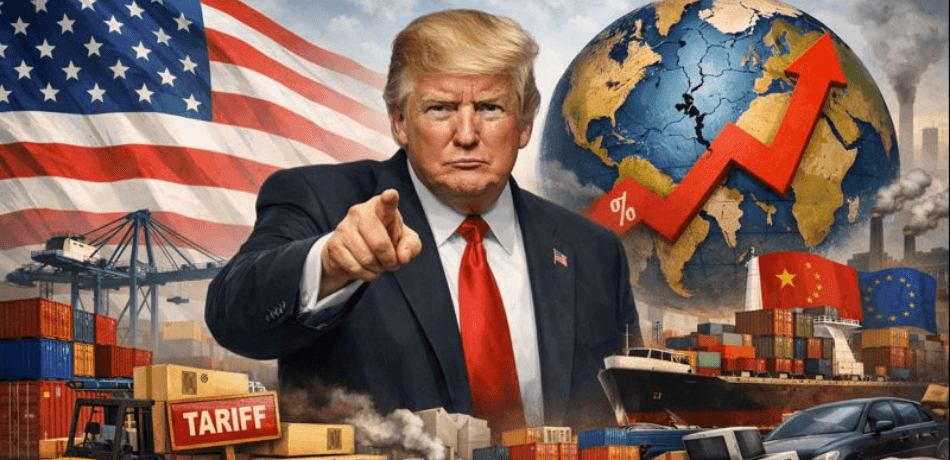
Table of Contents
Introduction: Why Investors Should Pay Attention
Trade decisions taken thousands of kilometres away can still influence the returns in an investor’s portfolio. When major economies change trade policies, the impact is felt across stock markets, sectors, and currencies worldwide.
In recent years, U.S. President Donald Trump’s tariff policies have significantly altered global trade flows. These changes affect company costs, export opportunities, and market sentiment—making it important for investors to understand how trade policy developments can influence investment outcomes.
Against this backdrop, it becomes essential to examine how tariff-led trade strategies are reshaping global commerce and what they imply from an investor awareness perspective.
What Are Tariffs and Why Do They Matter?
A tariff is a tax imposed on goods imported from another country. By increasing the cost of imported products, tariffs can influence pricing, production decisions, and overall trade volumes.
Governments typically impose tariffs to:
- Support domestic industries
- Encourage local manufacturing
- Reduce dependence on imports
However, tariffs can also increase input costs for businesses, disrupt established trade relationships, and introduce uncertainty into global markets—factors that investors closely track due to their impact on profitability and valuations.
Trump’s Trade Policy: A Simple Overview
President Donald Trump’s trade policy focused on protecting domestic economic interests. The key elements of this approach included:
- Imposition of higher tariffs on selected imports
- Renegotiation of existing trade agreements
- Strategic use of tariffs as leverage in trade negotiations
This marked a shift away from traditional free-trade practices and prompted companies and countries worldwide to reassess their sourcing, manufacturing, and export strategies.
How Tariffs Are Reshaping Global Trade
1. Diversification of Trade Relationships
To reduce reliance on single markets, countries and corporations are increasingly expanding trade across multiple regions. This diversification helps mitigate policy and geopolitical risks while creating alternative growth channels.
2. Reorganisation of Global Supply Chains
In response to tariff pressures, companies are restructuring supply chains by:
- Sourcing raw materials from alternative countries
- Increasing regional or domestic production
- Reducing concentration risk in manufacturing and logistics
In practical terms, businesses are changing where they source inputs and manufacture goods to manage costs and improve resilience.
3. Increased Policy-Driven Uncertainty
Frequent changes in trade policy have led to higher uncertainty for businesses and investors alike. This uncertainty can delay capital investment decisions and contribute to short-term market volatility.
Impact on Investors
Corporate Earnings
Higher import costs can compress operating margins, while trade restrictions may limit export revenues. These factors directly affect earnings visibility and company valuations.
Sector-Specific Effects
Tariff impacts vary across sectors:
- Export-oriented industries may face pricing and demand pressures
- Certain domestic manufacturing segments may benefit from reduced import competition
- Commodities, logistics, and infrastructure sectors may experience heightened volatility
Market Volatility
Trade-related announcements often lead to short-term fluctuations in equity and currency markets. Understanding the underlying policy drivers helps investors avoid reactionary decisions based on headlines.
How Investors Can Interpret Trade Developments
From an investor education standpoint, tariff-related developments should be viewed as:
- Indicators of short-term market volatility
- Signals of longer-term structural changes in global trade
- Influencers of sector performance rather than overall market direction
SEBI consistently encourages investors to prioritise fundamentals, diversification, and long-term financial goals instead of reacting impulsively to market news.
What Lies Ahead for Global Trade and Markets
Trade experts anticipate that global commerce will continue evolving toward:
- Greater regional and bilateral trade arrangements
- More diversified and resilient supply chains
- Increased sensitivity to geopolitical and policy developments
For investors, staying informed while maintaining discipline is essential in navigating these shifts.
What This Means for Retail Investors
While trade developments can influence market sentiment, they should not prompt immediate investment actions. Long-term investment outcomes are driven by:
- Business fundamentals
- Portfolio diversification
- Consistent, goal-oriented investment discipline
Conclusion
President Donald Trump’s tariff policies have reshaped global trade dynamics, influencing corporate strategies, economic relationships, and financial markets worldwide. For investors, understanding these policy-driven changes is an important part of market awareness and risk assessment.
Although tariff-related developments may introduce short-term volatility, a diversified, long-term investment approach focused on fundamentals can help investors navigate evolving global trade conditions effectively.
Key Investor Education Takeaways
- Trade policies influence markets and sector performance
- Tariffs can increase short-term market volatility
- Diversification helps manage trade-related risks
- Long-term investing should focus on fundamentals, not headlines
Disclaimer: This article is for educational and informational purposes only and does not constitute investment advice, recommendation, or solicitation. Investors should evaluate their risk profile and consult SEBI-registered financial advisors or intermediaries before making any investment decisions.